anarchy is a package for managed & beautiful chaos,
designed with incremental procedural content generation in mind. It
includes incremental & reversible random numbers, a selection of
distribution functions for random values, cohort operations that can be
applied incrementally to groups along an indefinite 1-dimensional space,
and function to incrementally/reversibly manage uneven distribution of
items among segments.
The goal is to give a high level of control to designers of PCG systems while maintaining incremental operation and reversibility.
Coming soon: fractal coordinates.
distribution sub-module, moved some
old cohort functions over to it. Fixed bugs & added
many tests. Added distribution_items and the
sumtable_* functions. Got rid of max_smaller
in favor of sumtable_segment.There are implementations of at least the core functionality available in C, C#, Javascript, Python, and Lua; this documentation applies most closely to the Python implementation, and it is drawn from that code. Each different language implementation has its own idiosyncrasies, but the higher-level things, like number and meaning of parameters, are the same for the core functions.
See the codeberg repository for source code plus links to the Lua documentation and to JavaScript examples.
Note: the anarchy Python package uses 64-bit integers, for compatibility with the C version of the library and for a larger output space. Technical limitations with JavaScript and Lua mean that the JS and Lua versions of the library effectively use 32-bit integers (stored inside 64-bit floats) and will therefore give different results.
The python version requires Python 3; tests use pytest
and require Python >=3.6.
The incremental shuffling algorithm can be used as a replacement for a standard random number generator in cases where you want to guarantee a global distribution of items and are currently using independent random number checks to control item distribution. For example, if you have code that looks like this…
def roll_item():
  r = random.random()
  if r < 0.01: # 1% chance for Rare item
    return "Rare"
  elif r < 0.06: # 5% chance for Uncommon item
    return "Uncommon"
  else:
    return "Common"
…you have no guarantees about exactly how often rare/uncommon items
will be, and some players will get lucky or unlucky. Instead, even if
you don’t know the number of roll_item calls, with
anarchy you can do this:
N = 0
seed = 472389223

def roll_item():
  global N, seed
  r = anarchy.cohort_shuffle(N, 100, seed + N//100)
  N += 1
  if r < 1:
    return "Rare"
  elif r < 6:
    return "Uncommon"
  else:
    return "Common"
In this code there are two extra variables that have to be managed in some way, but the benefit is that for every 100 calls to the function, “Rare” will be returned exactly once, and “Uncommon” will be returned exactly 5 times. Each group of 100 calls will still have a different ordering of the items, because it uses a different seed.
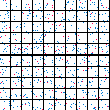
Here’s an image illustrating the differences between these two approaches: in the top half, results are generated using independent random numbers, while the bottom half uses anarchy’s cohort shuffling to guarantee one red cell and 5 blue cells per 10×10 white square..
There are many other potential applications of reversible/incremental shuffling; this is one of the most direct.
Deal with individual random numbers.
rng.prngrng.rev_prngrng.uniformrng.normalishrng.fliprng.integerrng.exponentialrng.truncated_exponentialDeal consistently with numbers in groups.
cohort.cohortcohort.cohort_innercohort.cohort_outercohort.cohort_shufflecohort.rev_cohort_shuffleDeal with items distributed evenly or unevenly among segments.
distribution.distribution_itemsdistribution.distribution_segmentdistribution.sumtable_for_distributiondistribution.sumtable_from_portionsdistribution.sumtable_totaldistribution.sumtable_segmentsdistribution.sumtable_itemsdistribution.sumtable_segmentrng.prngParameters:
x (int): The current random number (next one is
returned).seed (int): The seed; each seed will produce a distinct
sequence of numbers.Returns (int): The next random number in the sequence for the given seed.
A reversible pseudo-random number generator. Uses low-level
reversible functions to scramble a number and produce an hard-to-predict
result. The rev_prng function
is the inverse of this function.
rng.rev_prngParameters:
x (int): the current random number (previous one is
returned).seed (int): The seed; each seed will produce a distinct
sequence of numbers.Returns (int): The previous random number in the sequence for the given seed.
The inverse of prng (see above).
Returns the previous number in a pseudo-random sequence, so that:
prng(rev_prng(n, seed), seed) == n
rev_prng(prng(n, seed), seed) == nrng.uniformParameter (int): seed–The seed that determines the
result (could be a result from prng
or lfsr)
Returns (float): A pseudo-random number between 0 (inclusive) and 1 (exclusive).
rng.normalishParameter (int): seed–The seed that determines the
result.
Returns (float): A pseudo-random number between 0 (inclusive) and 1 (exclusive).
The result is created by averaging three results from uniform, and its distribution has a
normal-like shape centered at 0.5.
rng.flipParameters:
p (float): The probability of returning True.seed (int): The seed value that determines the
result.Returns (True or False): a decision value.
Flips a biased coin with probability p of being true.
Using the same seed always gives the same result, but over many seeds
the given probability is adhered to.
rng.integerParameters:
seed (int): The seed value that determines the
result.start (int): The minimum possible output value.end (int): One more than the maximum possible output
value.Returns (int): a pseudo-random integer between the start (inclusive) and the end (exclusive).
Returns a number drawn evenly from the given integer range, including the lower end but excluding the higher end (even if the lower end is given second).
Distribution bias is about one part in (range/2^63).
rng.exponentialParameters:
seed (int)–The seed that determines the result.shape (float):–The lambda shape parameter for the
exponential distribution. Values between 0.5 and 1.5 are typical, with
higher values biasing the distribution more towards smaller
results.Returns (float): A number with an exponential distribution on [0,∞).
Generates a number from an exponential distribution with the given lambda shape parameter.
See: this StackExchange answer on exponential distribution and the Wikipedia page for the exponential distribution
rng.truncated_exponentialParameters:
seed (int)–The seed that determines the result.shape (float)–The lambda shape parameter for the
exponential distribution. Values between 0.5 and 1.5 are typical, with
higher values biasing the distribution more towards smaller
results.Returns (float) A number with a truncated exponential distribution on [0, 1].
Generates a number from a truncated exponential distribution on [0,
1] with the given lambda shape parameter. See reference material for exponential.
cohort.cohortParameters:
outer (int): An integer to be assigned to a
cohort.cohort_size (int): The size of each cohort.Returns (int): Which cohort the given outer item is assigned to.
Simply returns the outer index divided by the cohort size, rounded down. Note that for extremely large integers, they will be truncated to fit within 64 bits.
cohort.cohort_innerParameters:
outer (int): An integer to be assigned to a
cohort.cohort_size (int): The size of each cohort.Returns (int): Where within its cohort the given integer ends up.
Computes within-cohort index for the given outer index and cohorts of
the given size, which is just the index modulus the cohort size. Like cohort, truncates to 64 bits.
cohort.cohort_outerParameters:
cohort (int): Which cohort
the item is in.inner (int): The index of the item in that cohort.cohort_size (int): The size of each cohort.Returns (int): The outer index that would be mapped to this within-cohort index.
This is the Inverse of cohort_and_inner: it computes the
outer index from a cohort number and inner index.
cohort.cohort_shuffleParameters:
inner (int): The index of an item in a cohort.cohort_size (int): The size of each cohort.seed (int): The seed that determines the shuffle
order.Returns (int): A new within-cohort index for the given item.
Implements an incremental shuffle, such that if you were to call cohort_shuffle on each
index in a cohort of a given size, each of the items would end up in a
different new spot within that cohort. The shuffle is reversible using
the rev_cohort_shuffle
function.
It works by composing several of the simpler reversible/indexable functions to produce a sufficiently complex operation that humans generally won’t be able to see the pattern it uses.
Note that this should not be used for cryptography or statistics: when the cohort size is even moderately large (say 100), the number of possible shuffles (constrained by the seed, which is 64 bits, so 2^64) will be much smaller than the number of possible orderings of the items, so not all possible orderings will be able to be produced.
Both the seed and the cohort size are used to determine the particular ordering of items, so the same seed with a different cohort size won’t necessarily produce a similar ordering to another run.
cohort.rev_cohort_shuffleParameters:
inner (int): The index of an item in a cohort.cohort_size (int): The size of each cohort.seed (int): The seed that determines the shuffle
order.Returns (int): A new within-cohort index for the given item.
Works just like cohort_shuffle, but
applies the same operations in the opposite order, so that:
seed = 478273827
y = cohort_shuffle(x, 100, seed)
x == rev_cohort_shuffle(y, 100, seed)distribution.distribution_itemsParameters:
segment (int): Which segment of a distribution we are
interested in.total (int): The total number of items being
distributed.n_segments (int): The number of segments to distribute
items among.segment_capacity (int): The capacity of each
segment.roughness (float in [0,1]): How rough the distribution
should be.seed (int): The seed that determines a specific
distribution.Returns (2-tuple of ints): the number of items from a distribution that come before the start of the given segment, and the number of items in that segment.
Note: Consider constructing a sumtable and using
sumtable_items instead for faster results at the cost of a
bit of memory (see sumtable_for_distribution).
Given that total items are to be distributed evenly
among n_segment segments each with at most
segment_capacity items and we’re in segment
segment of those, computes how many items come before this
segment and how many are in it. The roughness argument must
be a number between 0 and 1 indicating how even the distribution is: 0
indicates a perfectly even distribution, while 1 indicates a perfectly
random distribution. Does work proportional to the log of the number of
segments.
Note that segment_capacity * n_segments should be >= total.
distribution.distribution_segmentParameters:
index (int): Which item are we asking about.total (int): The total number of items being
distributed.n_segments (int): The number of segments to distribute
items among.segment_capacity (int): The capacity of each
segment.roughness (float in [0,1]): How rough the distribution
should be.seed (int): The seed that determines a specific
distribution.Returns (int): the index of the segment that the item of interest is distributed into.
Note: Consider constructing a sumtable and using
sumtable_segment instead for faster results at the cost of
a bit of memory (see sumtable_for_distribution).
Computes the segment number in which a certain item appears (one of
the total items distributed between segments; see
distribution_portion above). Requires work proportional to
the log of the number of segments.
Note that the index should be between 0 and
total - 1.
distribution.sumtable_for_distributionParameters:
total (int): The total number of items being
distributed.n_segments (int): The number of segments to distribute
items among.segment_capacity (int): The capacity of each
segment.roughness (float in [0,1]): How rough the distribution
should be.seed (int): The seed that determines a specific
distribution.Takes distribution parameters and returns a list containing the
cumulative sum of items in each segment. The list contains
n_segments entries, and each entry holds the sum of the
items from the total assigned to that segment plus all
earlier segments. This means that each entry is greater than or equal to
the entry to its left (and they’re only equal if zero items are assigned
to that segment). The last entry will be equal to the total.
n_segments times segment_capacity must be
>= total otherwise a ValueError will be
raised.
distribution.sumtable_from_portionsParameters:
portions (list of integers): A list where each entry
holds the portion of some total that’s assigned to a segment at that
index.Returns a sumtable for the same distribution, where entries are the
cumulative sum of all portions up to an index, rather than just the
portion at that index. Use functions like sumtable_total,
sumtable_segments, sumtable_portion, and
sumtable_segment to get information out of the sumtable
efficiently.
distribution.sumtable_totalParameters:
sumtable (list of integers): The table of cumulative
sums describing a distribution of items across segments.Returns the total number of items across all segments in a sumtable, which is just the last entry in that table.
distribution.sumtable_segmentsParameters:
sumtable (list of integers): The table of cumulative
sums describing a distribution of items across segments.Returns the number of segments in the given sumtable, which is just its length.
distribution.sumtable_itemsParameters:
sumtable (list of integers): The table of cumulative
sums describing a distribution of items across segments.i (int): The index to compute the items for.Returns a pair containing the number of items prior to the specified
segment and then the number of items in that segment, like
distribution_items, but for a sumtable.
distribution.sumtable_segmentParameters:
sumtable (list of integers): The table of cumulative
sums describing a distribution of items across segments.item (int): The item index out of the total items that
we want to figure out the segment for (starting from 0 for the first
item).Returns (int): The segment index that the given item falls into based on the sumtable.
Raises a ValueError if the sumtable is empty, and raises
an IndexError if the item index is too large for the
sumtable or if it’s negative.
Uses binary search to find the smallest sum in the given sumtable that’s larger than the given value breaking ties towards earlier entries. Works in time proportional to the logarithm of the sumtable size.