Recommendations for the Institution
In addition to discussing student recommendations, the focus group had a free-flowing conversation about the kinds of recommendations that could be proposed for faculty and leadership/administration, prompted by questions asked by the research team.
* Survey question nr. 18 in Survey Data. 227 out of 238 want some form of AI programs.
* Survey question nr. 15.4 in Survey Data. 161 out of 227 support involvement.
Key Visualizations from the Survey
Co-Designed Recommendations for Campus Roles
Select your role below:
Be clear about what 'AI' and 'GenAI' means.
AI is a very broad term that takes many different forms. Colloquially, since late 2023, as platforms such as ChatGPT, Gemini, and Claude have become more widespread, people have used the term 'AI' to mean generative AI or 'GenAI' such as the ones mentioned above. However, AI also includes algorithms used by Google Search and has become embedded into many platforms that are actively used in Higher Education, such as Persuall and our own Library Catalog.
In every class syllabus, clearly define acceptable versus unacceptable GenAI use, with examples. Periodically reiterate the policy orally in class.
As assignments such as papers and exams come up in class, professors can remind students what the appropriate use of GenAI looks like. Participants of our focus group suggested that providing examples of different platforms that are prohibited or permitted can help to clarify the extent to which GenAI is allowed in the classroom.
→ Context: Many students claimed to know that they weren’t allowed to use LLMs such as ChatGPT, but were unsure if Grammarly was permitted for their coursework.On the syllabus and orally in class, explain the rationale for the GenAI class policy.
Students expressed that understanding the reason why their professor has written a policy on GenAI will make them more willing to follow the rule. This might require thinking about what the learning goals of the class are, and how GenAI may enhance or prevent those goals.
→ Context: 78% of participants were more likely to adhere to the syllabus when the policy was given a justification (question nr. 2 in the survey).Foster a classroom dialogue with students about GenAI.
Faculty should engage with their students about their opinions on GenAI, providing them a platform to discuss their experiences, concerns, and perspectives on the technology as it relates to the expectations of their course.
→ Context: In the open-ended responses, 64 participants commented on or requested more discussion about the macro-structural impacts of GenAI, such as environmental destruction.Become better informed about GenAI and its impact.
Do some research about GenAI and its impacts and consider how it would be helpful or hurtful in your classroom. This requires understanding both how the technology works on a technical level and the impacts of its use.
→ Context: In the open-ended responses, 33 participants are critical of faculty's lack of GenAI literacy, while 31 are critical of faculty's uncritical embrace of the technology.Consider designing assignments with GenAI in mind.
Some students discussed desiring policies and assignments that level the playing field so that students who do not use GenAI are not disadvantaged compared to students who are able to use the technology without getting caught.
For example, some courses have designed assignments that must be done on paper during class time. Other assignments have been broken down into different stages, so that students must submit their progress at each stage to ensure that they are not using GenAI to write assignments for them entirely.
→ Context: 20 participants want to see policies and assignments that level the playing field so that students who refuse to use GenAI are not disadvantaged in courses where GenAI is permitted.Foster a classroom environment founded on trust.
Going back to the discussion of moral uncertainty, it seems as though some students who we categorized as 'AI Adopters' exploit any ambiguities within a syllabus to use GenAI if it makes their workload easier. At the same time, 60 participants claimed that when they encountered ambiguities, they just asked their professors or used a strategy of 'defensive non-use.' It seems like clarity about the GenAI policy and an openness to discussing it and the reasoning behind it will go some distance to building trust. But students also need to know that peers who violate course policy will face consequences. This is a challenging balance for faculty to strike. It would be valuable to have opportunities to discuss this issue together.
Career Education Collaboration
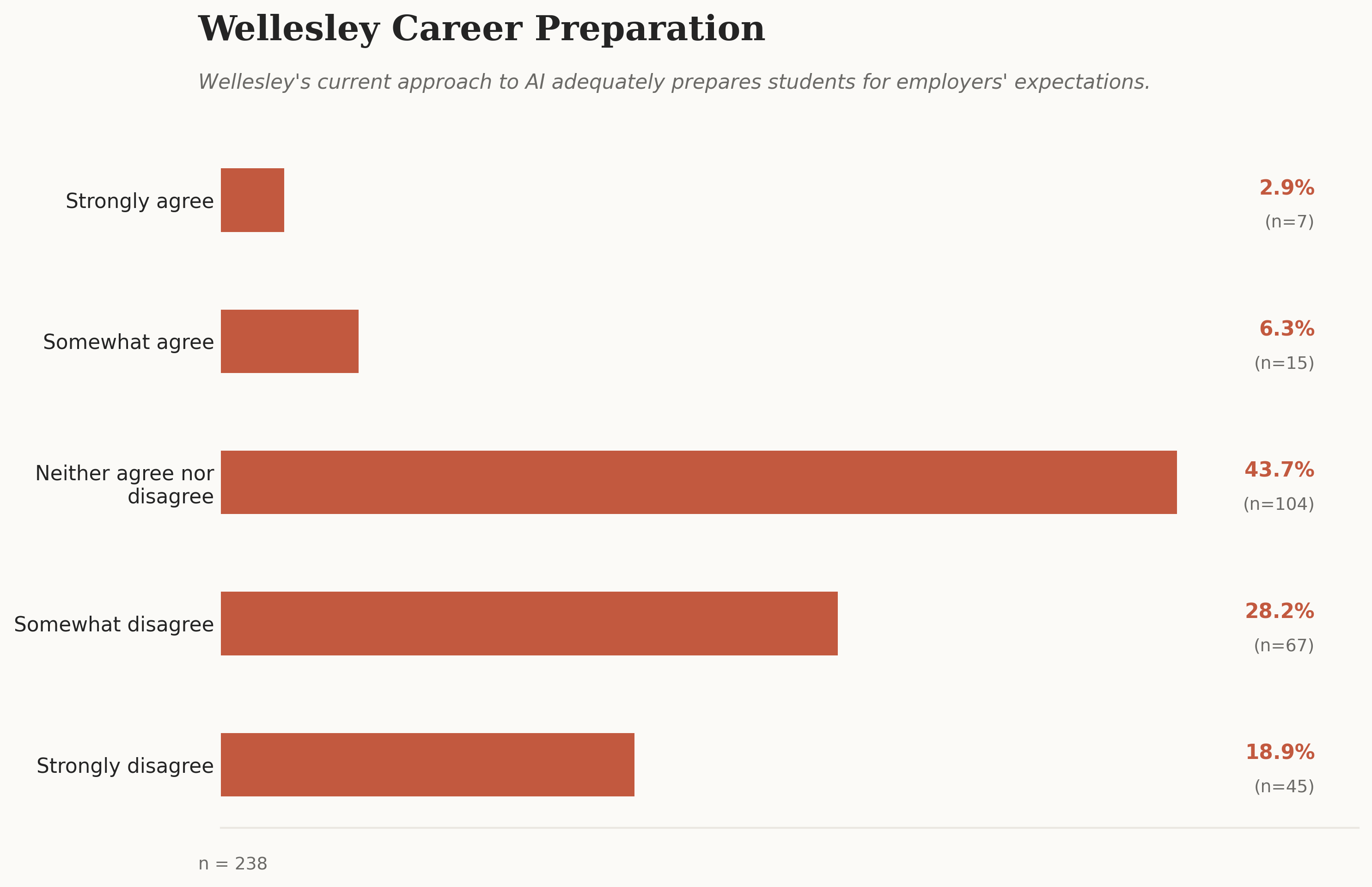
Career Education should work with academic departments, alums, and employers to provide students with specific guidance on the role of GenAI in professional settings.
Expectations surrounding GenAI differ across industries. Helping students understand what kinds of skills they should be developing in order to get a job in the field after graduation is essential.
→ Context: Career Education was listed as first (82%) for question 16.2 of the survey that asked who should support AI literacy. In the qualitiative analysis, 62 participants demand workforce/career positioning in which students are more informed about how GenAI is currently impacting their fields.Senior Leadership Policy Governance
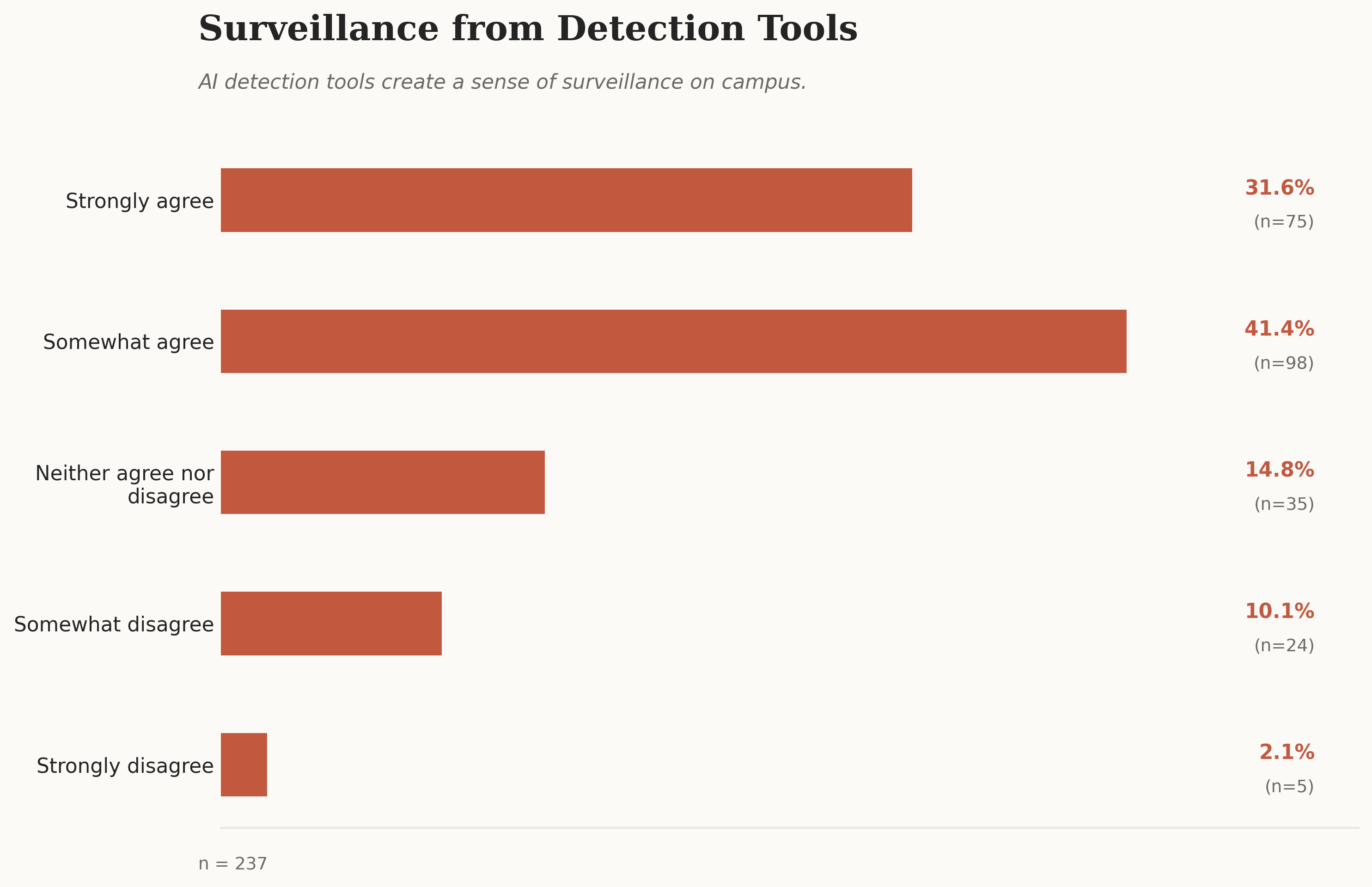
Surveillance-based approaches to GenAI in higher education have eroded trust between students, faculty, and the institution. Leadership should prioritize transparency in any future development of AI policies and governance.
→ Context: In the qualitiative analysis, 64 participants reject the adversarial dynamics of the classroom ("tough on crime" attitude); 63 students feared being falsely accused of using GenAI.Prioritize Regulation
The biggest and most important recommendation for senior leadership comes from the kind of governance that GenAI requires. Since regulation of GenAI in the world at large is low, prioritizing making decisions about how it should be treated at Wellesley College is imperative.
Governance & Deliberative Friction
Expand below to read about a theoretical framework for including multiple stakeholders in governance discussions.
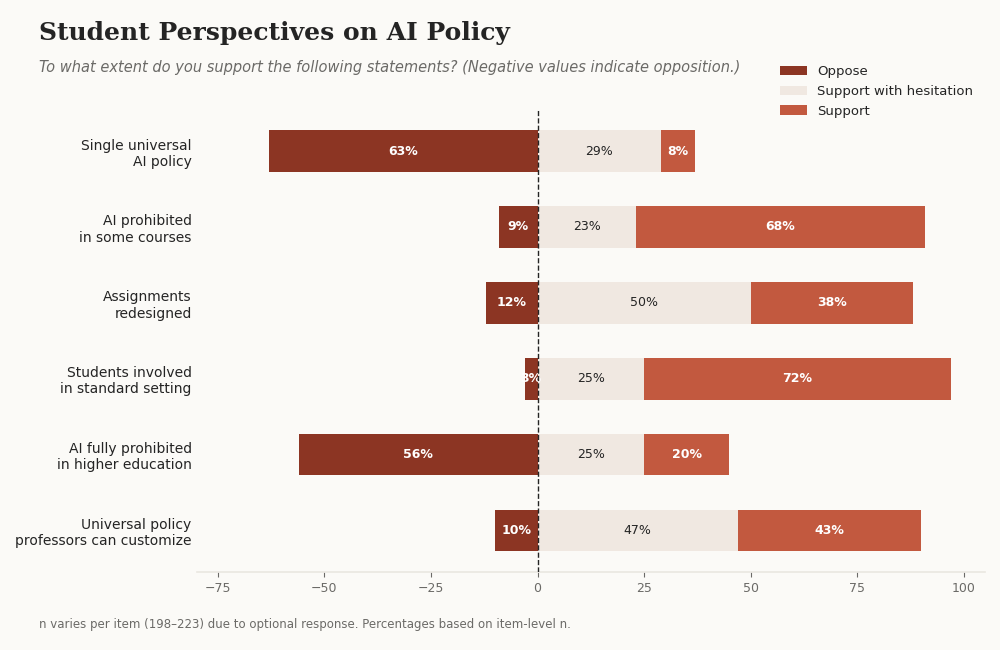
The survey data suggests that students are interested in a form of governance over GenAI, specifically ones that include them in the decision-making process. An overwhelming 95% of participants indicated an interest in participating in some form of discussion or campus program related to AI, suggesting that students desire engagement, education, and conversations about the technology. Additionally, 72% of students supported student involvement in the setting of GenAI standards across campus. These findings suggest participatory governance may be an appropriate approach to norm setting around this emerging technology. 20 participants requested collective agency.
A participatory lens is an approach to research and governance that treats the people who are most affected by a problem as critical contributors to understanding the dilemmas and creating a solution. This kind of governance aligns closely with Sasha Costanza-Chock’s Design Justice: Community-Led Practices to Build the Worlds We Need, which argues that stakeholders most affected by technologies should play a meaningful role in shaping them.11
"One of my professors had us write our own GenAI policy, which was helpful because it made each of us think critically about AI use. This is probably the best approach rather than a staunch anti-AI policy..." (Participant 19)
Further, the need for participatory governance is most important now, as GenAI has begun questioning and replacing many heuristic tools for democratic deliberation. This concern is understood through "echnological solutionism", a concept developed by Evgeny Morozov in To Save Everything, Click Here: The Folly of Technological Solutionism.12Morozov defines solutionism as “the ideology that legitimizes and sanctions” the belief that technology can and should solve human social problems. “All these attempts to fix the human condition—to reduce our biases by quantifying everything, to circumvent the frailties of our memory by recording everything…are indicative of Silicon Valley’s unease with imperfection as well as its glorification of the powerful tools at its disposal…When inefficiency is the result of a deliberative commitment by a democratically run community, there is no need to eliminate it, even if the latest technologies can accomplish that in no time.” For Morozov, inefficiencies and friction are features rather than bugs of the human condition. By removing the difficulties of working through problems on our own, technology's promise of quick fixes eliminates the deliberation process necessary for democracy. When inefficiency arises from moral hesitation or collective reasoning, eliminating it risks eroding the values of pluralism and reflection that are demanded by democratic social life. This idea of inefficiency that Morozov identifies is deeply rooted in capitalist ideals of productivity. The idea that AI could complete a task and reach the same conclusion in much less time than a human is seductive in a society that treats time as an essential and scarce resource that needs protection. However, Morozov believes that there is something democratic about inefficiency because it is a human trait that allows people to see things from multiple angles and to place value on deliberation over rash decision-making. GenAI challenges the value of inefficiency when it labels such qualities of impatience, stuckness, and confusion as problems that require solutions.
For Morozov, inefficiencies and friction are features rather than bugs of the human condition. By removing the difficulties of working through problems on our own, technology's promise of quick fixes eliminates the deliberation process necessary for democracy. GenAI challenges the value of inefficiency when it labels qualities of impatience, stuckness, and confusion as problems that require solutions.
Proposed Solution: A participatory approach to the governance of GenAI at Wellesley College would incorporate student perspectives into decisions made in the classroom and overarching decisions that the college may make about GenAI use and implementation. One way to implement this approach would be the creation of a GenAI advisory committee that is composed of students, faculty, staff, and administrators to review this emerging technology as it evolves. Student membership in such a committee would constitute a meaningful portion of the representation of the committee rather than merely a symbolic placeholder.