Introduction & Methodology
A Wellesley News editorial piece on Feb 2026, titled "On Wellesley's mAIrtyrdom", raised interesting questions about the campus climate with respect to GenAI. This inspired us to seek empirical evidence on how Wellesley students are thinking about GenAI's rapid disruption of learning and other academic experiences. Read below about the need to conduct such a survey and the details of the methodology we used.
Motivation & Introduction
Many institutions, including Wellesley College, are dealing with the effects of generative AI (GenAI) as these systems become increasingly ubiquitous and unregulated.1 GenAI tools such as Grammarly, ChatGPT, and Claude advertise to students of higher education with promises that their products can boost efficient writing, help to study for exams, take notes, synthesize readings, and more. Outside of educational contexts, advertisements present these features as efficient tools for problem solvers,2 efficiency-seekers,3 researchers,4 or for everyday questions5 in a variety of use cases and across different kinds of industries.
In institutions where GenAI use may be considered antithetical to their aims, like many educational contexts, teachers and professors have adopted policies forbidding students from using AI. In other institutions where speed and scale of output are prioritized, managers and bosses may mandate the use of such tools for their employees.6 Among students and workers alike, many have concerns about the negative effects of using GenAI, such as environmental degradation, job displacement, and deskilling. Cognisance of these downsides to using GenAI creates friction in institutions where administrators, professors, managers, bosses, or executives may be incorporating GenAI into the workflow, encouraging or even requiring its use. And, while some professors have banned AI in the classroom, others have made it a part of their curriculum, asking students to use it for specific tasks, which, in turn, can generate friction with students who prefer to do their work unaided by GenAI.
This friction has resulted in an urgent need to re-evaluate the autonomy of members of institutions with respect to their work. The advent of GenAI in educational institutions, in particular, has led to a dramatic increase in distrust. Professors do not trust their students to avoid using GenAI to do their work. Students do not trust their peers to follow “no-GenAI” policies in their classes. Students do not trust that their professors or the leaders of their institutions have their future career interests in mind when they set GenAI policies.
This erosion of trust can be seen in, for example, Princeton University's recent elimination of its 133-year-old policy of allowing students to write unproctored exams.7 This longstanding practice—a symbol of the institution’s trust in its student body—could not withstand the threat of students’ inappropriate use of GenAI. The agency that students once had to set their own exam schedules without a proctor has been eliminated in response to the perceived need to monitor student behavior to ensure that there is no inappropriate use of GenAI. The erosion of trust ushered in by GenAI in academic spaces has now been monetized by the very companies that push their products onto students. In the process of writing this very paper, the authors were shown an ad from Grammarly for a new feature that allows its users to “prove where [their] words come from.”8 “Grammarly Authorship” is an authenticator that shows the history of the written text, and whether it was typed by a human, copied and pasted from an AI tool, or edited by Grammarly. This tool allows students to “submit [their] most transparent work.”9 Educational environments are now ecosystems rife with distrust, where companies that developed and promoted the tools that generated the distrust are now capitalizing on technological “solutions” to prove that one is trustworthy.
To better understand how these mechanisms are affecting Wellesley College students, we sent out a survey probing current experiences of policy, campus climate, governance preferences, and perceived career implications of the growing GenAI industry. Our goal was to gauge how Wellesley students felt about the presence of GenAI on campus in the years following ChatGPT’s release to the public in late 2022—the inflection point of the boom of widespread access to GenAI. Despite a solid and growing body of research on GenAI in higher education,10 student perspectives remain comparatively understudied. Our research shows that students' attitudes are spread across a spectrum with two distint poles: one characterized by openness to GenAI and the other by resistance to it. Despite this divide, most students reported similar levels of campus distrust and surveillance, suggesting that trust erosion extends beyond individual attitudes towards GenAI. We found ethical ambiguity, opaque policy, and unclear governance structures as structural contributors to an environment of distrust.
One prominent theme that emerged from the data was that of agency as students attempt to solidify their moral stances about using GenAI in the context of their academic work in a moment when quick, easy, and free models are literally at their fingertips. While some students have hard moral lines against using GenAI for academic purposes, others see value in using these tools; still others, who may not yet have a clear idea about the value, have nevertheless given in to temptation and used the tools. Many students reported taking an individualist approach to decision-making around GenAI use based on personal moral codes, whether their actions align with syllabus policies or not. This expression of agency seems correlated with an individual’s development of their own understanding of the technology and its effects. As people read the news about GenAI from diverse sources, have varying levels of experience with GenAI, and different political perspectives, opinions on GenAI vary widely.
Methodology & Execution
Our exploratory study was formalized around a survey instrument designed to probe the intersections of current policy awareness, day-to-day workflow adaptation, and student sentiment regarding GenAI. Questions were balanced between fixed Likert-scale fields measuring overall concern, desire for fluency in the tools and their usage, satisfaction with college communication about the role of GenAI on campus, and free-response questions targeting specific points of friction that students may be experiencing. All survey questions and results can be found in the Survey Data page.
During the period of April 23rd to May 7th, 2026, various student members of LEED lab sent multiple emails to various Wellesley mailing lists inviting students to participate in the survey. Posters were also put up around campus with QR codes linking to the survey, including the Science Center, the dormitories, the academic quad, and Lulu Chow Wang. Students were encouraged to participate in the survey with the chance to win one of ten $15 gift cards for El Table and one of two $50 gift cards to the Wellesley Bookstore through a daily raffle. Reminders to fill out the survey were sent together with the announcement of daily winners of the raffle. The survey was entirely anonymous, no emails or any other information (class year, major, etc.) was collected. It was administired through Qualtrics and at the end it contained a link to a separate Google Form to optionally enter the email to participate in the raffle. At the end, our survey was completed in its entirety by 238 participants.
Survey results were cleaned to remove incomplete responses, and open-ended responses were separated from quantitative responses. Quantitative data were first analyzed using descriptive statistics, namely, relative frequencies, and visualized as bar charts (these can be found in the Survey Data page). Exploratory analyses were later conducted using cross-tabulation.
Additionally, to identify meaningful subgroups within the sample, latent class analysis (LCA) was performed. Seven variables were used in fitting the model: level of overall concern about AI, desire for AI fluency, changes in approach to coursework, clarity of AI policy’s impact on adherence, whether Wellesley’s approach to AI makes them feel prepared for the workforce, and two items about policy preferences. We receveived a sample of N = 178 after pairwise deletion. Model fit indices were evaluated to determine the optimal number of classes, and a three-class model was selected for both interpretability and fit. The three classes are referred to throughout this report as AI Resisters, AI Ambivalents, and AI Adopters. You can read about them in the Data Analysis page.
Participants with missing quantitative data were assigned to LCA classes by two independent coders based on content from qualitative responses. Five participants could not be classified due to insufficient qualitative data and were excluded from further class-based analyses.
Chi-square tests of independence were used to examine whether response distributions on survey items varied significantly across classes.
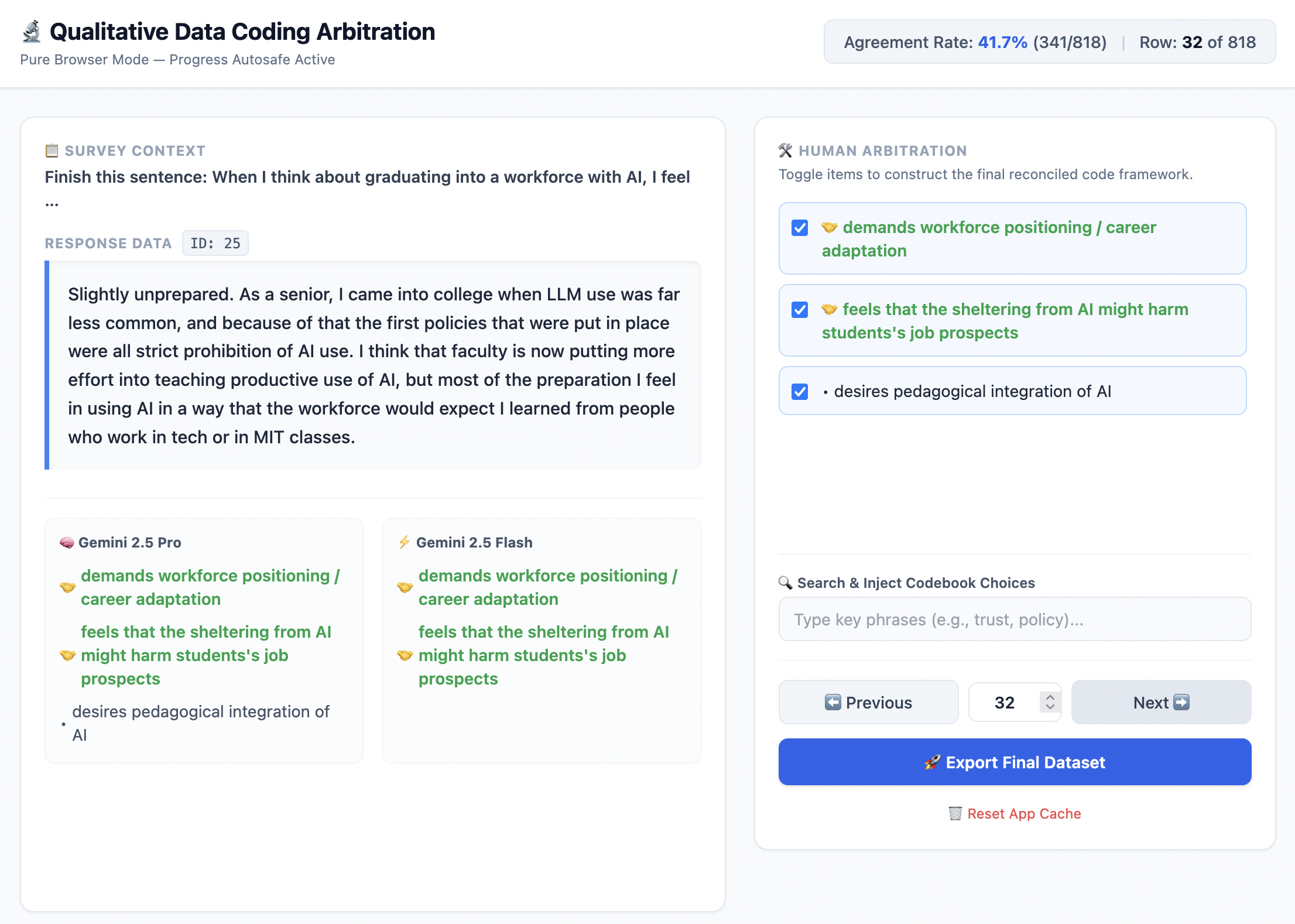
A total of 818 responses across seven open-ended questions were analyzed using a codebook developed by two members of the research team. Each response was then analyzed by both Gemini 2.5 Flash and Gemini 2.5 Pro using the established codebook.
Following the Gemini coding of the open-ended questions, one member of the research team manually reviewed all 818 responses and all the codes assigned by the two Gemini models. To streamline this process, the team built a custom Qualitative Data Coding Arbitration Tool that displayed participant responses alongside side-by-side predictions from both Gemini models, allowing the human reviewer to toggle agreement, resolve model discrepancies, or inject missing codes.
This human reconciliation served as the final stage of the qualitative coding process. The finalized qualitative data was then aggregated to calculate participant frequencies for each code.
in July 2026, after we completed the quantitative and qualitative analysis, our research team ran a focus group of 14 Wellesley students to gain more information about how students should respond to the increase of GenAI usage at Wellesley. The participants in the focus group were asked to adopt the persona of either an AI Adopter, AI Resister, or AI Ambivalent (the three personas uncovered by our analysis). From the perspective of their assigned persona, we asked them to review a set of proposed recommendations for our campus, assess how they might be received, and, where relevant, discuss models for implementation. The focus group participants were recruited from the students who were participating in the two summer research programs on campus for social sciences and natural sciences. The meeting happened during lunch time and lunch was offered.
Our recruitment method left open the possibility of skewed data due to selection sampling bias. These results are intended to present preliminary findings that could serve as a springboard to motivate future, formal surveys on the part of the institution. Here are some additionals limitations related to our methodology:
- While our overall sample is N=238, the sample used for modeling the data through LCA is N=178.
- Because our sample is entirely anonymous to ensure honest responses, we cannot identify which of the academic groups (humanities, social sciences, STEM) correlates with AI adoption, ambivalence, or resistance. A survey by OIR could be able to reveal such correlations, if they exist.
- While the coding book for the qualitative analysis was developed by a team of three humans, the coding was performed by two GenAIs. Only one human reviewed the codes assigned by the GenAI coders, possibly introducing subjective coder bias.
References
- 1 Anandarajan, M. (2026, January 29). Why a lack of governance will hurt companies using agentic AI. Fast Company. https://www.fastcompany.com/91479520/why-a-lack-of-governance-will-hurt-companies-using-agentic-ai
- 2 Anthropic and Claude. (2025, September 18). Keep thinking with Claude. YouTube. https://www.youtube.com/watch?v=FDNkDBNR7AM
- 3 OpenAI. (2026, April 27). Ritu vs Case Files | With ChatGPT. YouTube. https://www.youtube.com/watch?v=2TGHO4apQ5I
- 4OpenAI. (2026, April 16). Introducing GPT-Rosalind for life sciences research. https://openai.com/index/introducing-gpt-rosalind/
- 5Google. (2024, May 29). Prompt your way with Gemini. YouTube. https://www.youtube.com/watch?v=9bBfYX8X5aU
- 6https://fortune.com/2026/04/09/ai-backlash-quiet-quitting-fobo-obsolete-white-collar-rebellion/
- 7 Keane, I. (2026, May 13). Princeton scraps honor code and will supervise exams for first time in 133 years because of AI. The Independent. https://www.the-independent.com/news/world/americas/princeton-proctor-exams-ai-b2976111.html
- 8Grammarly. (n.d.). Authorship. https://www.grammarly.com/authorship
- 9Grammarly. (n.d.). Authorship. https://www.grammarly.com/authorship
- 10 Hashmi, N., & Bal, A. S. (2024). Generative AI in higher education and beyond. Business Horizons, 67(5), 607-614. https://doi.org/10.1016/j.bushor.2024.05.005
- 11Costanza-Chock, S. (2020). Design justice: Community-led practices to build the worlds we need. MIT Press.
- 12 Morozov, E. (2013). To save everything, click here: The folly of technological solutionism. PublicAffairs.